We are developing a recommendation system in collaboration with oneroots株式会社 (2-3-12 Kanda-Sudacho, Chiyoda-ku, Tokyo). The system has already been implemented by a major digital manga distribution service.

Recommendation Systems
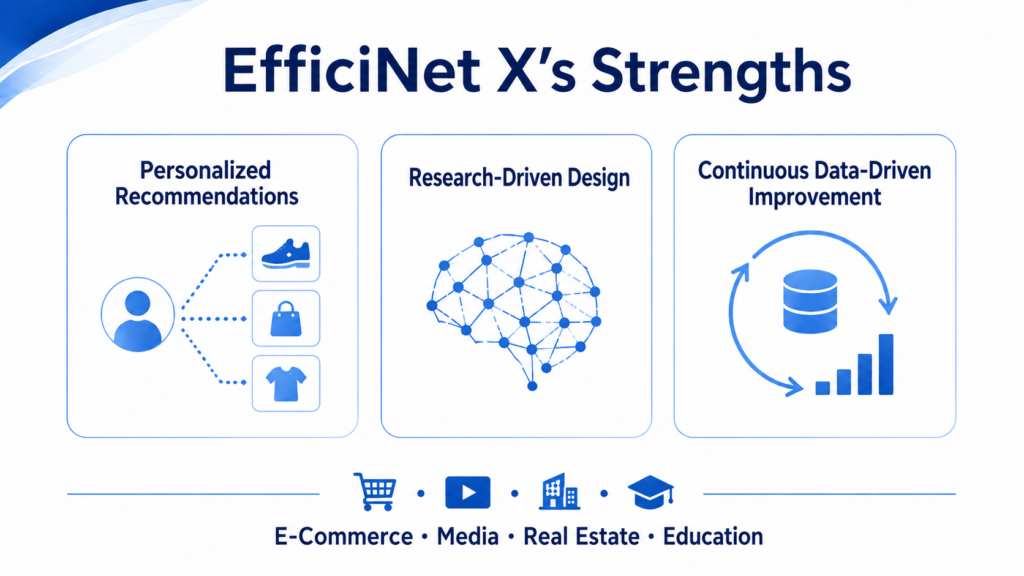
EfficiNet X specializes in developing recommendation systems that deliver the most relevant information, products, and services based on each user’s behavioral history and contextual data. We provide end-to-end support for recommendation engines across a wide range of industries—including e-commerce, media, real estate, and education—from requirements definition and algorithm design to implementation and continuous operational improvement.
Our recommendation systems help users quickly find the information they are looking for, contributing to lower churn, higher return rates, increased purchase conversion, and greater engagement. Rather than merely optimizing display rankings, we design recommendation logic aligned with each client’s business objectives and desired user experience, supporting the development of recommendation platforms that deliver sustainable results in real-world services.
Our CEO, Nakamura, has conducted research on the multi-armed bandit problem, one of the foundational theories behind recommendation systems, and has presented his findings at international conferences and in academic journals, including AAAI, AISTATS, and Neural Computation. A key strength of EfficiNet X is its ability to translate the theoretical expertise developed through his doctoral research into robust algorithms that can be designed and implemented for real-world applications.
View Nakamura’s research publications here↗
Our team also includes specialists in statistical analysis, machine learning, causal inference, and data analytics. We support the entire data-driven development cycle—from log design and feature engineering to offline evaluation and online A/B testing—providing practical recommendation systems that contribute to business growth and an improved user experience.
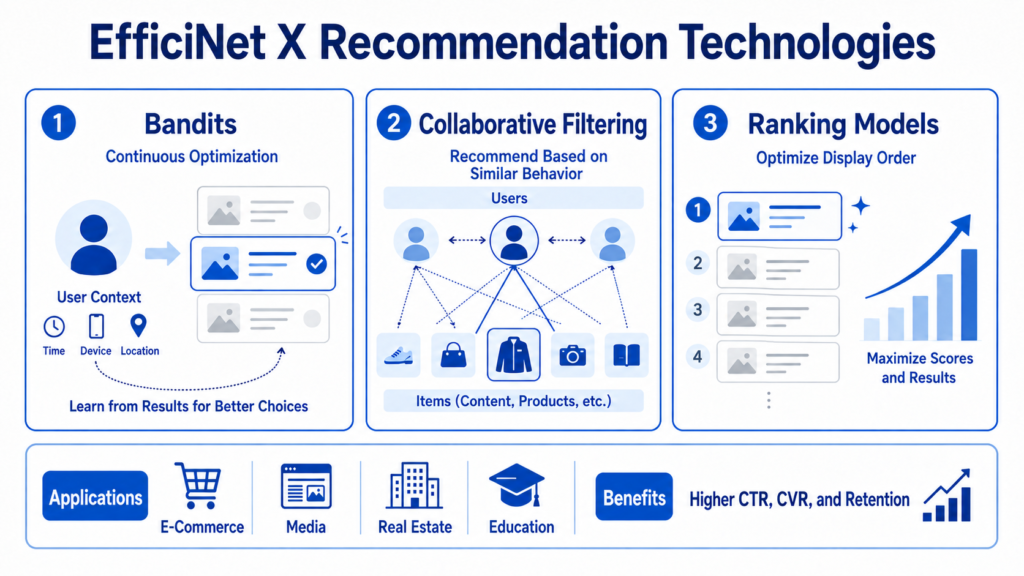
Recommendation Algorithms We Support
EfficiNet X selects from multiple recommendation algorithms based on the characteristics of each service and its business KPIs. Beyond simply displaying recommended products, we help design and implement recommendation systems that use behavioral and contextual data to improve click-through rates, conversion rates, and user retention.
1. Multi-Armed Bandits and Contextual Bandits
Multi-armed bandit algorithms determine which option should be presented to a user and when. For example, when multiple banner ads, campaigns, coupons, learning materials, or articles are available, the algorithm learns from actual user responses and continuously improves which option should be prioritized to achieve the best results.
A key feature of this approach is its ability to balance exploring options that have not yet been sufficiently tested with leveraging options that have already demonstrated strong performance. This makes it possible to continuously improve KPIs such as click-through rates, conversion rates, purchase rates, and course completion rates during operation.
Contextual bandit algorithms also take into account information such as user attributes, browsing history, time of access, device type, and referral source. This makes it easier to present the most appropriate option for each individual and situation, rather than showing the same content to every user.
At EfficiNet X, bandit algorithms are applied to scenarios that can be continuously optimized based on online user responses, including banner and landing-page selection, coupon delivery, content and video recommendations, and the adaptive delivery of learning materials.
Please also see the related article by Mr. Kudo of oneroots↗
2. Collaborative Filtering
Collaborative filtering is one of the most widely used techniques in recommendation systems.
Simply put, it makes recommendations based on the idea that users who have behaved similarly are likely to have similar preferences. For example, it recommends products purchased or content viewed by other users whose purchase and browsing histories resemble those of a particular user.
This technique is used across a wide range of services, including e-commerce sites, video streaming platforms, news apps, recruitment services, and real estate portals.
Even when users have not explicitly rated items, their preferences can be inferred from behavioral data such as views, clicks, purchases, favorites, and time spent. This makes collaborative filtering particularly effective for services that handle large numbers of users and items, as it can deliver highly personalized recommendations.
At EfficiNet X, we analyze relationships between users and between items to build recommendation systems that suggest products, articles, properties, educational materials, and other content tailored to each individual user.
3. Ranking Models Using LightGBM and Similar Algorithms
In real-world services, deciding what to recommend is only part of the challenge. Determining the order in which recommendations are displayed is equally important.
For example, even when the same ten products are recommended, click-through and purchase rates can vary significantly depending on whether the items most likely to interest the user appear at the top. Ranking models are used to optimize this display order.
LightGBM is a machine learning library capable of learning rapidly from large datasets and is widely used in production recommendation systems and ranking optimization. It combines information such as user attributes, past behavior, item characteristics, prices, categories, time of day, devices, and referral sources to predict which items should be ranked highest.
At EfficiNet X, we design ranking models aligned with key business KPIs, including click-through rates, purchase probability, inquiry rates, and retention rates. This enables content and products to be presented in the order most likely to generate results for each user, rather than simply by popularity or recency.
The Value EfficiNet X Delivers
Successful recommendation-system implementation requires more than simply selecting an algorithm. It is essential to design the entire process—including what data to collect, which KPIs to optimize, how to evaluate effectiveness, and how to continuously improve the system after deployment.
EfficiNet X combines technologies such as multi-armed bandits, collaborative filtering, and ranking models according to each service’s objectives and data environment. We provide end-to-end support—from log and feature design to model development, offline evaluation, A/B testing, and ongoing optimization—building recommendation platforms that enhance both the user experience and business outcomes.