Research & Product Development
A Complex World Calls for Collaborative Intelligence
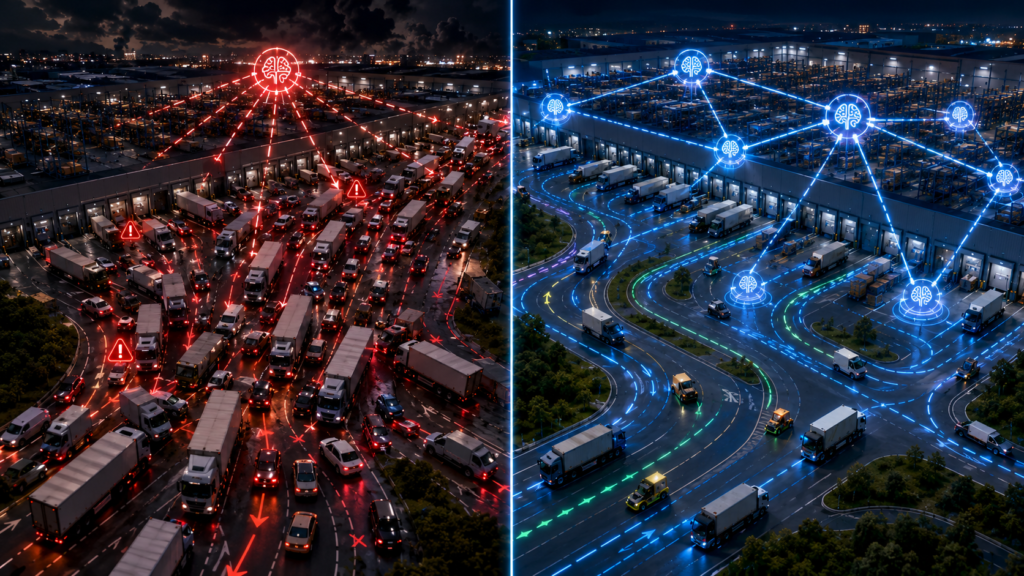
In today’s world, a wide range of players—including people, robots, vehicles, equipment, departments, companies, and systems—operate simultaneously and influence one another. As a result, optimizing each component individually can sometimes make the overall system less efficient.
For example, even if one robot selects the shortest route, congestion will occur if every robot takes the same path. Similarly, even if each department optimizes its own operations, the company as a whole may still face inefficiencies in inventory, delivery schedules, and customer service.
What complex environments require is not AI that makes excellent decisions in isolation, but AI that coordinates with others to make better decisions for the system as a whole.
We conduct research and development on this kind of “team-based AI,” or multi-agent AI.
Multi-Agent Deep Reinforcement Learning Library
We are developing a multi-agent deep reinforcement learning (MARL) library that enables multiple AI agents to learn and act collaboratively.
Designed not only for research but also for real-world applications in logistics, energy, manufacturing, mobility, and simulation, it serves as a versatile development platform. Its Python-based architecture makes it easy to use and integrate with existing machine learning environments, enabling engineers to implement and evaluate solutions efficiently.
Through this library, EfficiNet X is expanding the technological foundation for implementing Collaborative AI.
Multi-Agent Path Planning Library
We are developing a Multi-Agent Path Finding (MAPF) library that enables multiple robots and vehicles to reach their destinations efficiently while avoiding collisions with one another.
It is a versatile development platform with applications in warehouse transportation, factory logistics, autonomous mobile robots, mobility systems, and traffic simulations.
Its Python-based architecture makes it easy to use and supports route generation and validation in environments containing large numbers of agents and obstacles. Through this library, EfficiNet X is expanding the technological foundation that enables multiple moving agents to coordinate safely and efficiently.
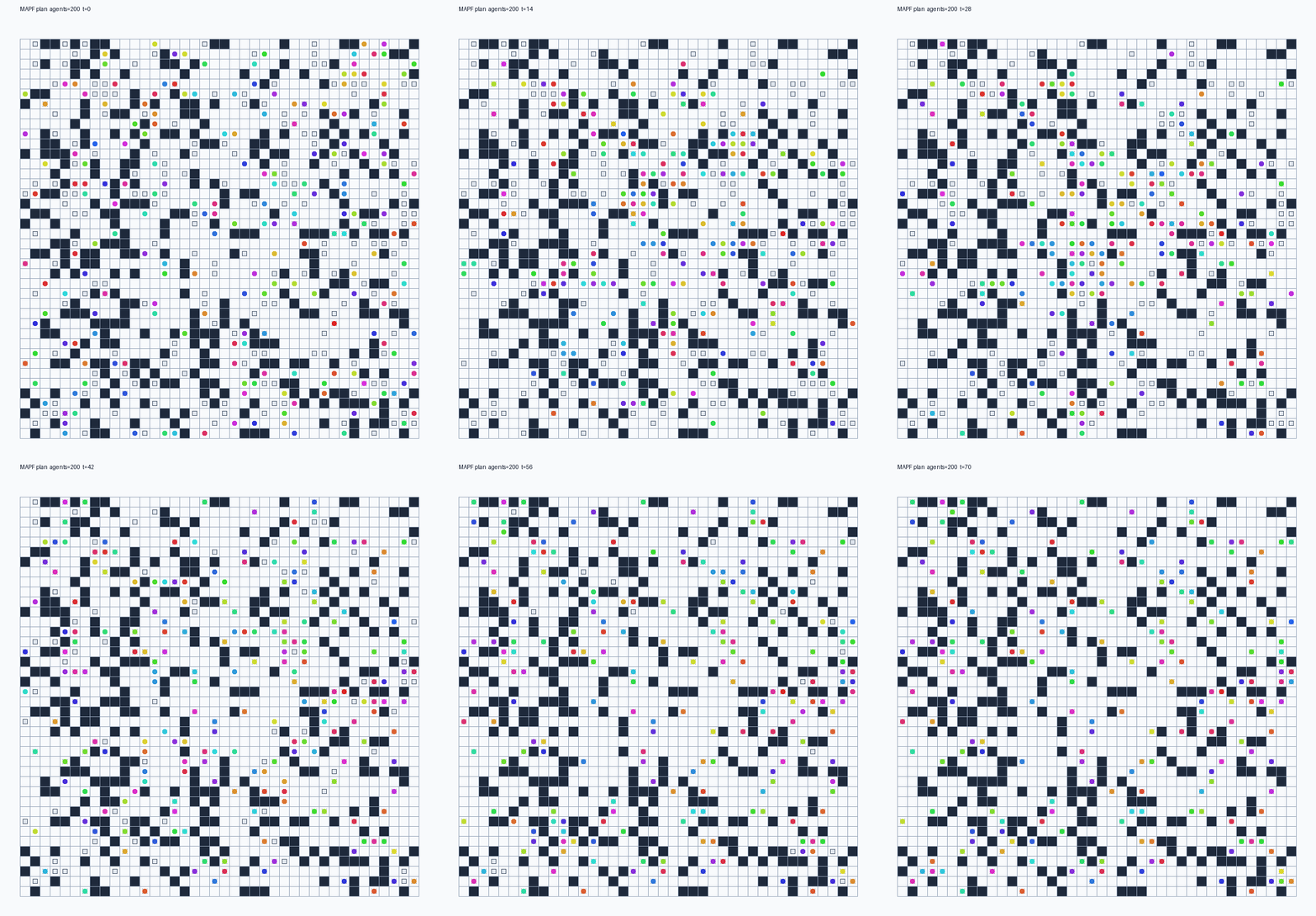
Our proprietary library enables high-speed route planning for every robot.
AI- and Drone-Powered Bear Damage Mitigation Support System
We are conducting research and development on an AI- and drone-powered bear management support system to reduce injuries and agricultural damage caused by bears while ensuring the safety of personnel responding in the field.
The system is designed to detect and track bears in real time using drone footage and consolidate information such as their location, direction of movement, surrounding conditions, and response history on a single screen. After reviewing the live footage and detection results, authorized personnel will be able to remotely assess the situation and issue instructions for appropriate measures, including deterrence, capture, or removal.
Human approval will be required before any action is taken, helping to minimize false detections and misidentification while reducing the need for personnel to enter hazardous areas or approach bears directly.
Going forward, we plan to integrate coordinated operation of multiple drones, analysis of past bear sightings, risk prediction, and notification functions for local residents and relevant authorities. Through these efforts, we aim to contribute to safer and more effective measures for preventing and mitigating bear-related damage.